
When you hear the words “legally blind,” what do you picture?
Complete darkness? A person who cannot see anything at all? Someone navigating every part of life without usable vision?
That is not always what legal blindness looks like.
Many people who are legally blind can still detect light, recognize shapes, see movement or use portions of their remaining vision. Others may see relatively clearly in the center but have an extremely limited field of view. The experience varies because legal blindness is a measurement—not one specific way of seeing the world.
So, how blurry is legally blind? Let’s put the numbers into focus.
First, What Does 20/20 Vision Mean?
Most of us have heard the phrase “20/20 vision,” but the numbers are easy to misunderstand.
Having 20/20 vision means that when you stand 20 feet from an eye chart, you can see what a person with standard vision is expected to see from 20 feet away.
It does not mean that your vision is perfect. Visual acuity only measures how clearly you can identify details at a particular distance. It does not fully measure:
- Peripheral vision
- Depth perception
- Color vision
- Night vision
- Contrast sensitivity
- How well your eyes work together
- The overall health of your eyes
Someone can read the 20/20 line and still have an eye condition that affects another part of their vision.
What Does 20/200 Vision Look Like?
In the United States, a person generally meets the definition of legal—or statutory—blindness when their vision cannot be corrected to better than 20/200 in their better-seeing eye.
Here is what that measurement means:
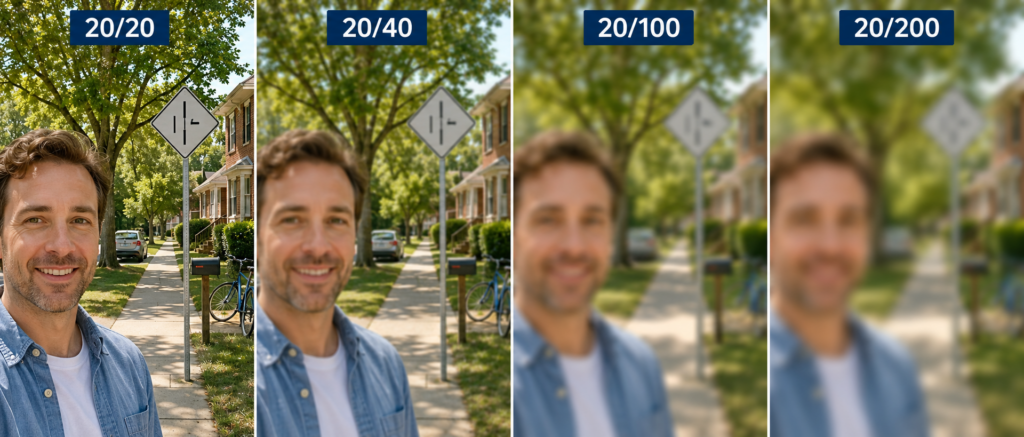
A person with 20/200 vision must stand approximately 20 feet away to see an object that someone with 20/20 vision may be able to see from 200 feet away.
Imagine seeing a familiar face across a room. With 20/20 vision, you may recognize the person almost immediately. With 20/200 vision, that face may appear heavily blurred, with the smaller details nearly impossible to distinguish.
Letters on a sign may blend together. Objects may lose their defined edges. Navigating an unfamiliar environment may become much more difficult.
But that does not necessarily mean the person sees nothing.
Visual suggestion: Show the same everyday scene at 20/20, 20/40, 20/100 and 20/200. Use a street sign, a face and several background objects so readers can compare the loss of detail.
Legal Blindness Is Not Always About Blur
Here is where the definition becomes more complicated: Visual acuity is only one way a person may qualify as legally blind.
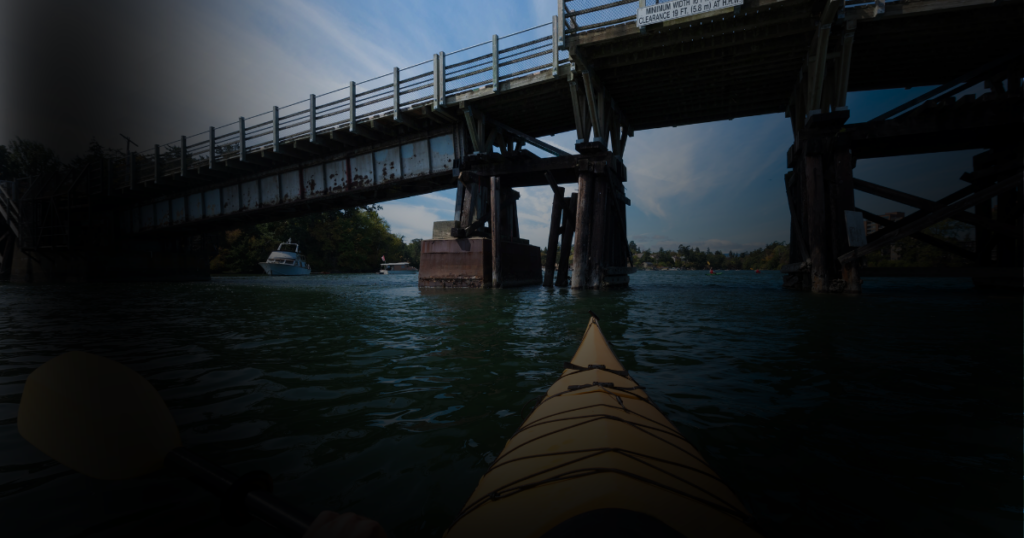
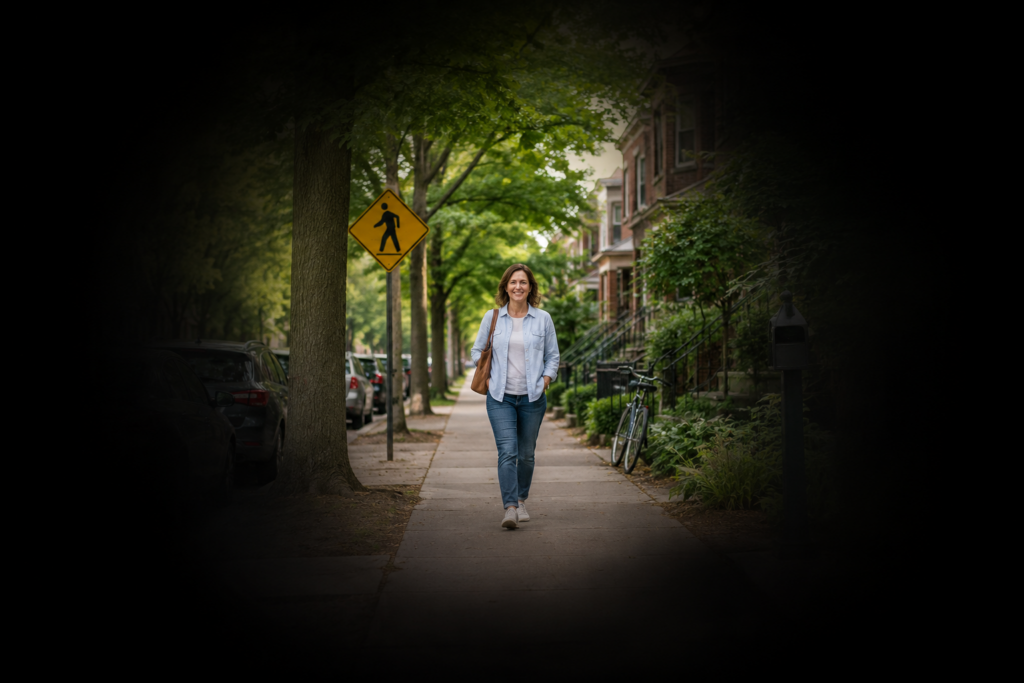
A person may also meet the federal definition if the widest diameter of their visual field in the better eye is no greater than 20 degrees. This is sometimes described as severe tunnel vision.
A person with this type of vision loss may be able to see an object directly in front of them relatively clearly. However, they may not see a person approaching from the side, an obstacle near their feet or a vehicle entering their path.
Think about looking through a narrow cardboard tube. The center may be visible, but much of the surrounding scene disappears.
According to the Social Security Administration’s definition of statutory blindness, either best-corrected central visual acuity of 20/200 or less in the better eye or a qualifying visual-field restriction can meet the legal standard.
Visual suggestion: Place a 20-degree circular window over a normal photograph to demonstrate severe peripheral vision loss. Keep the center clear while darkening or removing the surrounding scene.
Why One Blur Filter Cannot Tell the Whole Story
It would be convenient if we could apply one filter to a photograph and say, “This is exactly what legal blindness looks like.”
But that would be inaccurate.
Different eye conditions affect vision in different ways:
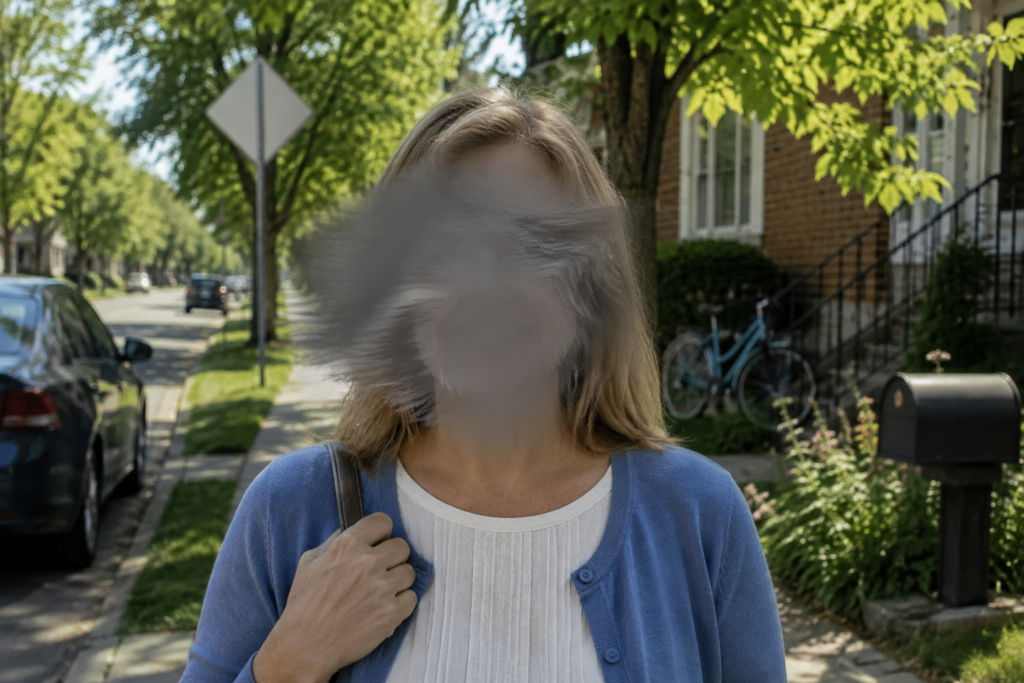
Macular Degeneration
Age-related macular degeneration can damage central vision. A person may struggle to read, recognize faces or see fine details while retaining more of their peripheral vision.
Visual suggestion: Create a scene with a blurred, distorted or missing area in the center while leaving the outer edges more visible.
Glaucoma
Glaucoma can gradually damage peripheral vision. Because the changes may begin at the edges, people do not always notice the loss immediately.
Visual suggestion: Show a clear center surrounded by increasingly dark or missing peripheral areas.
Cataracts
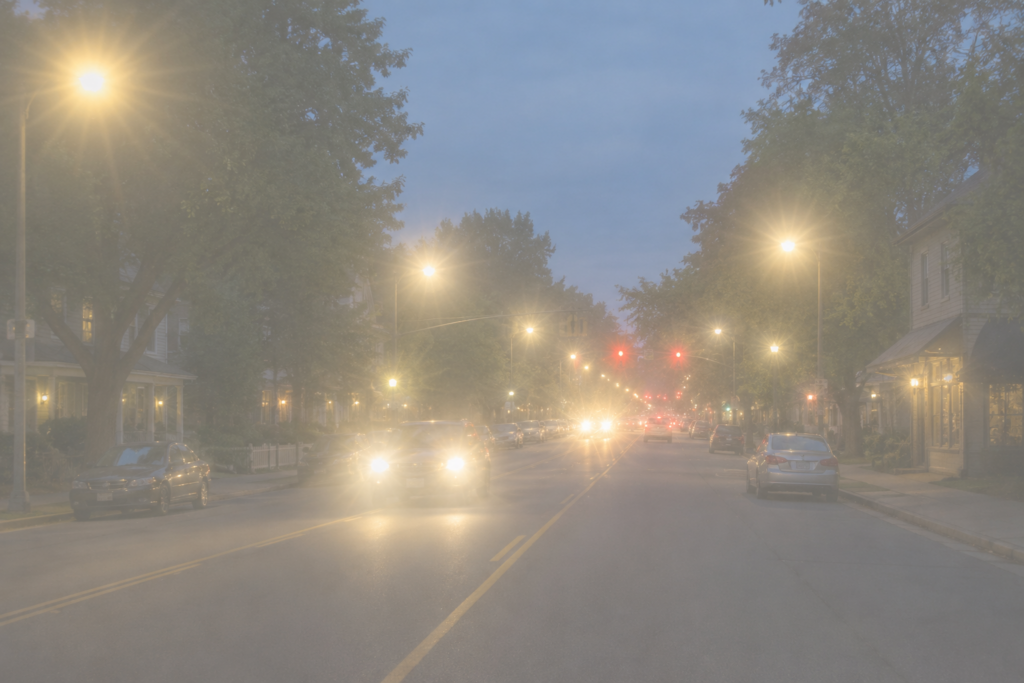
Cataracts may cause vision to appear cloudy, hazy or washed out. Colors may look duller, glare may become more intense and nighttime driving may become especially difficult.
Visual suggestion: Add a cloudy film, muted colors and bright halos around headlights or streetlights.
Diabetic Retinopathy
Diabetic retinopathy can cause blurred vision, dark areas, floating spots or patches of missing vision. The appearance may change depending on the location and severity of retinal damage.
Visual suggestion: Add scattered dark spots, blurred patches or irregular areas of missing detail.
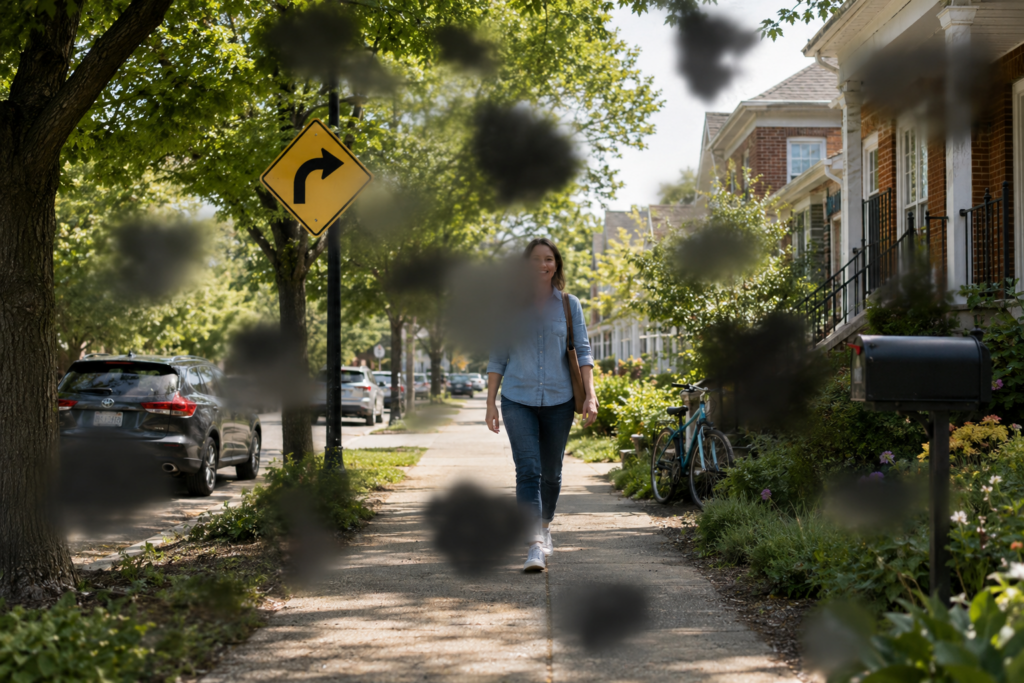
These visuals can help build understanding, but they are only approximations. No simulation can perfectly recreate another person’s vision or represent every stage of an eye disease.
Does Wearing Strong Glasses Mean You Are Legally Blind?
No.
This is one of the biggest misconceptions surrounding the term.
Someone may have extremely blurry vision without glasses but achieve clear vision once their prescription is applied. Legal blindness is based on the vision in the better-seeing eye after the best possible correction.
In other words, having a strong glasses or contact lens prescription does not automatically make someone legally blind.
The question is not simply, “How blurry is your vision without glasses?” The question is, “How well can your vision be corrected?”
Can Someone Who Is Legally Blind Still Read or Work?
Yes.
Legal blindness does not describe a person’s intelligence, independence or ability to participate in everyday life. Depending on their remaining vision and individual needs, a person may use:
- Magnification devices
- Screen readers
- High-contrast settings
- Large-print materials
- Specialized lighting
- Orientation and mobility training
- Vision-rehabilitation services
- Assistive technology
Some people who are legally blind can read, work, travel independently and perform many familiar activities by adapting how they use their remaining vision.
The National Eye Institute explains that vision rehabilitation can help people with permanent vision loss maximize their remaining sight and continue completing everyday tasks.
Why Regular Eye Examinations Matter
Some causes of serious vision loss develop slowly and may not produce obvious symptoms in their earliest stages. By the time a person recognizes that something is wrong, permanent damage may have already occurred.
A comprehensive eye examination can evaluate much more than your ability to read an eye chart. It allows your eye doctor to examine the health of your eyes and look for signs of conditions such as glaucoma, cataracts, diabetic eye disease and macular degeneration.
If you notice new blind spots, distorted vision, worsening peripheral vision, sudden blurriness, flashes, floaters or other changes, do not wait for your next routine appointment. Contact an eye care professional promptly.
Legal Blindness Does Not Look Just One Way
Legal blindness is not a single blur level—and it does not always mean total darkness.
For one person, it may mean severe loss of detail. For another, it may mean seeing the world through a very narrow field. Someone else may experience missing central vision, cloudy vision or irregular patches of visual loss.
The visuals help us imagine those challenges, but the most important lesson is this: You cannot determine the health of your eyes based only on how clearly you think you see.
Schedule a comprehensive eye examination with McFarland Eye Care and let our team help protect the vision you depend on every day.